Insights & Updates

Insights on pricing strategy, value-based methodologies, and go-to-market excellence for B2B leaders.

April 29, 2026Rashaqa Rahman

How to Increase Price Without Losing Your Best Customers

Are you putting off raising your pricing because you are worried about churn? Have your costs creeped up while your prices remained static? Do you suspect that your customers are getting an extraordinary deal for the price you are charging them?A well designed price increase can reset the relationship between the value you create and the value you capture. It can also fund continued investment in your product or service. However, done badly, it can erode trust, accelerate churn, and provide an opening to your competitors.The good news is that the customers most leaders fear losing in a price increase - that is, the larger deals, or most loyal or engaged customers, are rarely the ones who actually leave. The customers who leave are usually the ones you suspected were a poor fit anyway. But that only holds true when the price increase is well designed, well communicated and well executed.Segment Before You Raise PriceIf you service multiple customer segments -  not every customer should see the same increase. Different segments derive very different amounts of value from your offer in very different ways, and a flat price increase applied across the board is the wrong way to go.We recently worked with a SaaS organization whose pricing had not kept pace with how their customers were using the product. Heavy users derived enormous value from the platform, but paid roughly the same as light users on the same flat plan. So we designed a price increase that was structured around usage and value tiers. Heavy users absorbed a meaningful price increase because it was possible to articulate and quantify the value they were getting. Light users saw a small increase or none at all, with a clear pathway to more value creation over time.So start by segmenting by value before you decide who pays what.Start with ValueA price increase without a credible value story is just a bill that went up. A price increase rooted in a credible value story re-anchors the relationship with your customersAsk yourself honestly, what has changed since you last set prices? Have you introduced new capabilities? Are there new customer outcomes? Are there new industry benchmarks, or have you broadened your reach to new customer categories? Most organizations do not document the value they have added over the years. So start by surfacing it and quantify where possible. The value-based narrative you bring to support the  pricing increase determines whether there will be customer price acceptance or pushback..Choose the Right MechanismConsider whether you should be:Introducing a new pricing tier and migrating customers upAdjusting or introducing new pricing metrics (the unit by which you price) so it tracks how value is actually created - for example number of users, number of transactions, volumeRepackaging - moving features between tiers in a way that that better tracks value          Applying time-based phasing - applying the increase to new customers now, and existing customers at renewalThe best price increase mechanism for your business requires a deep understanding of how your customers buy, how they renew, and how much flexibility there is in your pricing architecture today.Communicate with ConfidenceThe single most common mistake we see is apologetic communication. A hesitant, defensive announcement signals to customers that you do not believe the new price is fair. Your customers will take their cue from you.So, be direct. Explain what is changing, when, and why. Most importantly anchor every communication in value. Give customers enough notice to plan. For your most strategic accounts, start early and have a real conversation with someone they trust.Protect the Right Customers, StrategicallyDo not grandfather everyone who pushes back. Grandfathering should be a strategic choice, not the default. Grandfather customers only when the relationship is genuinely strategic -  when the cost of churn is materially higher than the cost of the foregone increase.The Ones Who LeaveSome customers will leave, that is inevitable. The customers who churn over a well designed, well communicated price increase are usually the ones who were never getting fair value relative to the price being charged. A well designed and executed price increase is a clear signal that an organization understands the value it creates and that it intends to keep investing in ongoing value creation for its customers.We Can HelpAt GTM Pricing Innovations, we help B2B organizations design and execute price increases that capture a fair share of the value they create for their customers. If you have a price increase on the horizon and need support with execution, or you have been putting one off, or you are unsure where to start, we would love to talk.Reach out to us - let us help you with pricing design that strengthens your customer relationships rather than tests them.
April 28, 2026Karen Chiang

Building a Habit of Voice of Customer in 30 Days - Part 4 of 4 Operationalize

Week 4 (Days 22–30): Operationalize — Execute a Real DecisionThe difference between a VoC project and a VoC capability is this: a project ends with a report. A capability ends with a decision, a change, and a measurement plan. This final week of establishing your VoC habit, you make VoC real.Actions for the week:Pick one decision and execute it. Rewrite a section of your website using the outcome language your customers gave you. Adjust a pricing tier based on the value gap you identified. Change a qualification question in your sales process to reflect how customers actually describe the trigger for buying. One change, fully implemented.Instrument the impact. Define in advance what you'll measure: win rate, time-to-close, expansion rate, NPS, churn. You don't need a perfect attribution model — you need a baseline and a hypothesis. "If we reposition for this outcome, we expect demo-to-close to improve within sixty days."Set the cadence for what comes next. VoC doesn't end on Day 30. Schedule  regular VoC reviews; perhaps, thirty minutes with RevOps, GTM, and product to share one new insight and make one visible decision. This is how the muscle stays active.Document your first VoC cycle. Write a one-page internal summary: what you heard, what you changed, and what you're measuring. This becomes the template for every cycle that follows.What good looks like by Day 30: One GTM decision — messaging, packaging, pricing, or qualification — has been made and implemented based on direct customer evidence, with a measurement plan in place.Execution is Our Core MetricGTM Pricing helps commercial teams turn Voice of Customer from a sporadic exercise into a disciplined habit that shapes messaging, packaging, and pricing decisions every week. By partnering with GTM Pricing, you give your revenue operations, sales, and product leaders a shared, value‑based language grounded in real customer outcomes, not internal opinions.We deliver data-backed, operationalized strategies—not just theoretical advice. Our commitment is to ensure our recommendations are fully integrated through your Revenue Operations (RevOps) so that strategy actually sticks and scales.Want a clearer growth trajectory with predictable sustainable revenue? Let’s connect on LinkedIn! Contact me at GTM Pricing.Karen Chiang, Founder, Managing Director, Strategy & InnovationsGTM Pricing Innovations Inc.

April 27, 2026Karen Chiang

Building a Habit of Voice of Customer in 30 Days - Part 3 of 4 Synthesize

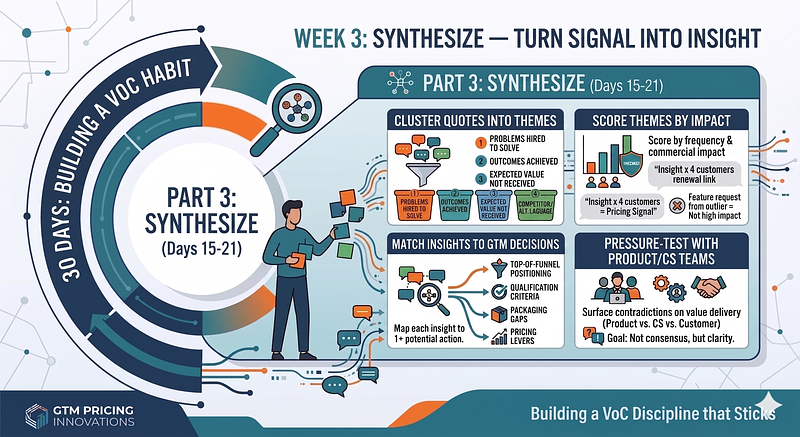
Week 3 (Days 15–21): Synthesize — Turn Signal Into InsightLast Friday, I posted about how to listen. Listening is not enough; Raw VoC is not useful. Synthesized VoC — organized, compared, and connected to decisions — is where the value compounds. Without synthesis, even the richest customer conversations stay trapped as anecdotes, disconnected from the pricing, packaging, and positioning decisions that drive revenue. Synthesis is the discipline of moving from what you heard to what it means: organizing customer language into patterns, weighing those patterns by frequency and commercial impact, and connecting them directly to the GTM decisions your team needs to make.Actions for the week:Cluster the quotes into themes. Group customer language by: (1) problems they hired you to solve, (2) outcomes they've achieved, (3) value they expected but didn't get, and (4) language they use to describe competitors or alternatives. Four buckets. Keep it simple.Score the themes by frequency and commercial impact. Not all insights are equal. An outcome mentioned by four out of five customers and linked to renewal decisions is a pricing signal. A feature request from one outlier account is not.Match insights to GTM decisions. For each high-frequency theme, ask: Does this change how we should position at the top of the funnel? Does it change a qualification criterion? Does it reveal a packaging gap? Does it suggest a pricing lever we're not using? Map each insight to at least one potential action.Pressure-test with your product and CS teams. Share your synthesis in a thirty-minute working session. The goal isn't consensus — it's to surface whether what customers are telling you contradicts what your internal teams believe about value delivery.What good looks like by Day 21: You have a synthesis report that maps customer language to commercial decisions, with a ranked short list of three to five changes worth testing.Execution is Our Core MetricGTM Pricing helps commercial teams turn Voice of Customer from a sporadic exercise into a disciplined habit that shapes messaging, packaging, and pricing decisions every week. By partnering with GTM Pricing, you give your revenue operations, sales, and product leaders a shared, value‑based language grounded in real customer outcomes, not internal opinions.We deliver data-backed, operationalized strategies—not just theoretical advice. Our commitment is to ensure our recommendations are fully integrated through your Revenue Operations (RevOps) so that strategy actually sticks and scales.Want a clearer growth trajectory with predictable sustainable revenue? Let’s connect on LinkedIn! Contact me at GTM Pricing.Karen Chiang, Founder, Managing Director, Strategy & InnovationsGTM Pricing Innovations Inc.
April 24, 2026Karen Chiang

Building a Habit of Voice of Customer in 30 Days - Part 2 of 4 Listen

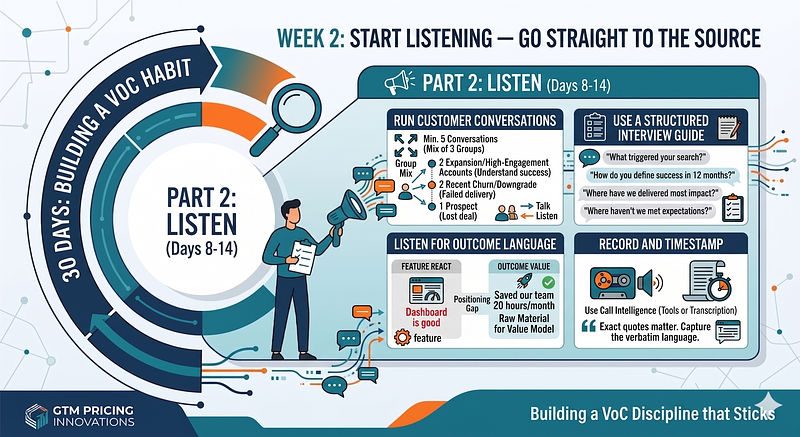
With completion of week 1,  you know exactly where your VoC gaps are. Now it's time to close the most important gap: the distance between what your team believes about customer value and what customers are actually saying.While audits tell you what you're missing. Conversations tell you what actually matters.Week 2  is about structured listening — not generic check-ins, but purposeful conversations designed to surface how customers define value in their own words.Actions for the week:Run five customer conversations, minimum. Prioritize a mix: two expansion or high-engagement accounts (to understand what's working), two recent churn or downgrade accounts (to understand where you failed to deliver value), and one prospect who evaluated you but didn't buy. These three groups give you the full arc.Use a structured interview guide. Ask every customer the same core questions: "What triggered the search that led you to us?" "How do you define success twelve months from now?" "Where have we delivered the most impact?" "Where haven't we met your expectations yet?" How do you see us, compared to our competitors? Consistency across interviews is what makes the synthesis in Week 3 possible.Listen for outcome language, not feature language. When a customer says "it saves my team hours on reporting," that's a value statement. When they say "the dashboard is good," that's a feature reaction. You want outcome language — it's the raw material for your messaging, your value model, and your pricing logic.Record and timestamp. Use call intelligence tools or basic transcription. Exact quotes matter more than paraphrases. You'll want the verbatim language.What good looks like by Day 14: You have five recorded, structured conversations with timestamped notes and at least ten direct customer quotes describing outcomes, friction points, or unmet expectations.Execution is Our Core MetricGTM Pricing helps commercial teams turn Voice of Customer from a sporadic exercise into a disciplined habit that shapes messaging, packaging, and pricing decisions every week. By partnering with GTM Pricing, you give your revenue operations, sales, and product leaders a shared, value‑based language grounded in real customer outcomes, not internal opinions.We deliver data-backed, operationalized strategies—not just theoretical advice. Our commitment is to ensure our recommendations are fully integrated through your Revenue Operations (RevOps) so that strategy actually sticks and scales.Want a clearer growth trajectory with predictable sustainable revenue? Let’s connect on LinkedIn! Contact me at GTM Pricing.Karen Chiang, Founder, Managing Director, Strategy & InnovationsGTM Pricing Innovations Inc.
April 23, 2026Karen Chiang

Building a Habit of Voice of Customer in 30 Days - Part 1 of 4 Diagnose

Most B2B SaaS companies say they listen to customers. Very few have made it a repeatable discipline. If you’ve read my previous posts, I stress that there's a big difference between collecting customer feedback and operationalizing Voice of Customer (VoC). This gap is exactly where GTM strategies are put at risk or fall apart, pricing lacks proper insight, and churn quietly accelerates.Your team will not be VoC experts in 30 days; however, 30 days is enough to build the habit of VoC, instrument the right systems, and make your first real decision — on messaging, packaging, or pricing — grounded in what customers are actually telling you. VoC is a muscle that needs constant  strengthening. Companies that compound VoC into a genuine competitive advantage don't run an annual listening program — they build a rhythm. Every customer conversation sharpens your value story. Every win/loss analysis tightens the qualification criteria. Every renewal conversation becomes an input to the next pricing iteration.Over time, VoC becomes the connective tissue between your customers' lived reality and your GTM strategy, your value architecture, and your pricing model. In a market where both human buyers and autonomous buying agents are evaluating you, your ability to speak precisely in the language of customer outcomes is no longer a nice-to-have. In this four part series, I provide a 30 day plan to build a habit of voice of customer.Start here with week 1.Week 1 (Days 1–7): Diagnose — Know What You're Working WithYou cannot fix what you haven't identified. Before you run a single customer interview, spend the first week auditing your current state of VoC. Where does it currently live in your organization and/or where does it not exist.Actions for the week:Map your current VoC sources. Pull together every place customer signals currently live: ie. Net Promoter Score (NPS) surveys, support tickets, win/loss notes, call recordings, renewal conversations, product usage data, and any customer advisory board outputs. Understand who owns each of these and how often they're reviewed.Identify the blind spots. Where in the customer journey are there blind spots.  Most companies have reasonable signals at renewal (because churn is painful) and almost nothing at the evaluation stage (because typically deals close and the team moves on). Audit your current messaging for customer language. Pull your homepage, your sales deck, and your last three outbound sequences. Does the language reflect how your best customers describe the problem you solve — or more about how your product team describes your features? The gap between those two is your positioning risk.Assign a VoC owner. In a previous post, I mentioned that Revenue Operations (RevOps) is the natural owner for VoC. If not, this is the time to make the case. RevOps orchestrates the systems — Customer Relationship Management (CRM), Customer Success (CS) platforms, product usage telemetry, billing — where the richest VoC signals live. As such, centralize ownership with RevOps.What good looks like by Day 7: You have your VoC audit that shows every existing signal source, the gaps across the journey, and a named owner accountable for the next three weeks.Execution is Our Core MetricGTM Pricing helps commercial teams turn Voice of Customer from a sporadic exercise into a disciplined habit that shapes messaging, packaging, and pricing decisions every week. By partnering with GTM Pricing, you give your revenue operations, sales, and product leaders a shared, value‑based language grounded in real customer outcomes, not internal opinions.We deliver data-backed, operationalized strategies—not just theoretical advice. Our commitment is to ensure our recommendations are fully integrated through your Revenue Operations (RevOps) so that strategy actually sticks and scales.Want a clearer growth trajectory with predictable sustainable revenue? Let’s connect on LinkedIn! Contact me at GTM Pricing.Karen Chiang, Founder, Managing Director, Strategy & InnovationsGTM Pricing Innovations Inc.
April 22, 2026Rashaqa Rahman

De Facto Discounting: Why Revenue Targets Slip and Sales Plateau

Have you watched a quarter close strong on deal count but weak on revenue? Do you have a consistent, healthy pipeline, while the revenue line keeps flattening out? Do you worry that discounting, which was meant to be an exception, has become the default path to closing a deal?If so, you are not alone. Missing revenue targets despite steady sales, and watching sales growth plateau even in a growing market, are common patterns we often see across B2B organizations. While this may seem like a sales execution problem, more often than not, they are symptoms of a pricing and go-to-market problem.The Discount SpiralIn many organizations, discounting starts as a tool to win specific deals, but it rarely stays that way. Once sales learns that discounting has the potential to get a deal to the finish line, discounting becomes the de facto strategy. What begins as a 5% concession on a strategic logo can turn into 15% on the average deal and 25% on competitive deals.The cost to the organization can quickly compound. Every dollar discounted is a dollar that can never be recuperated. Worse still, ad-hoc discounting anchor customer expectations for renewals, expansion and referrals. Over time, the fair price you would have liked to charge becomes a pipedream that nobody actually pays.We recently worked with a growing SaaS business whose sales team consistently hit deal close targets but missed revenue targets - the diagnosis was that the pricing design had no discounting guardrails, no value-based tiering, and no playbook for defending price. Without these, the sales team defaulted to discounting.The Sales PlateauSales plateaus may be a signal that the part of the market you have been winning in has been won or saturated, and the next segment needs a different approach - different packaging, different pricing metrics, and a different value conversation.Organizations that plateau often have one go-to-market motion, one package, and one price. That works until it does not. When the initial segment is saturated and the next customer segment has a different willingness to pay or a different definition of value, the same offer stops landing.When different customer types are being sold against the same price list you may be overcharging one segment resulting in churn, while another segment may be underpaying for the value they were getting, and leaving a lot of money on the table for you. This is because pricing design and value positioning is not one size fits all.Two Symptoms, One Root CauseBoth discounting and plateauing can be traced back to the same root cause: a pricing strategy that is not aligned with how value is created, delivered and communicated across segments.If your revenue is being eroded by discounting, ask:Do our sellers have a value narrative strong enough to defend price in a competitive market?Do we have a disciplined discount approval structure, or is it too discretionary?Does our packaging give our sales team levers other than price – contract terms, service levels, features?If your revenue is plateauing, ask:Have the segments we win today been saturated, and what does the next segment actually value?Do we have one price and one package for customers who derive very different value from our offer?Is how we price still aligned with how our customers perceive and measure value, or have we outgrown them?Answering these questions honestly is uncomfortable. It usually means something that used to work is no longer working. But the organizations that do this proactively are the ones that climb out of the discounting spiral and overcome the plateau.Pricing is not an afterthought. It is one of the most powerful levers you have to meet your revenue targets.We Can HelpAt GTM Pricing Innovations, we help B2B organizations turn pricing into a strategic engine for growth. If your team is discounting more than you would like, or your revenue curve is flattening out, we would love to talk.Reach out to us - let us help you build a pricing strategy that defends your value, scales with your segments, and gets you back on your growth trajectory.