GTM Pricing Innovations

Most pricing is a back-office decision.
Yours can be a competitive advantage.

We build pricing on what your customers actually value — quantified through Voice of Customer, packaged for sales to defend, and validated by the market.

15 questions · 5 minutes · no financial data needed · free

The Value Cycle Diagnostic

Find out where your go-to-market motion is breaking down.

5

Stages of the value cycle

15

Behavioral questions

~5 min

To complete

1:1

Personalized result

Begin the diagnostic →

Answer honestly — questions describe practices, not aspirations.

Our methodology

We don't guess. We listen, then quantify.

Most B2B pricing is a guess. The cost shows up in discounting, quiet churn, and leaking margin.

Voice of Customer is the foundation of everything we do — a structured discipline of listening, pattern recognition, and quantification, mapped across the five stages of the value cycle.

01

Create

Are you building products around real customer value drivers — or features your team finds interesting?

02

Communicate

Can sales articulate value the way buyers experience it — or are they pitching features?

03

Deliver

Are customers actually realizing the value you sold — or quietly churning?

04

Document

Do you have a paper trail of value delivered — or do renewal conversations start from zero?

05

Capture

Is your pricing capturing the value you deliver — or leaving margin on the table?

Featured case study

A healthcare pricing migration, rebuilt around value.

A healthcare software company's good-better-best migration was stalling. We rebuilt it around value: cohort segmentation, tested messaging, and sales training. The new model landed with near-universal customer acceptance, three months ahead of schedule.

Read the full case study

94%

Acceptance

+20%

Revenue

−3 mo

Ahead

Latest thinking

From our team.

All insights →
May 15, 2026Edward A Wong

Where Your Go-To-Market Motion Is Breaking Down

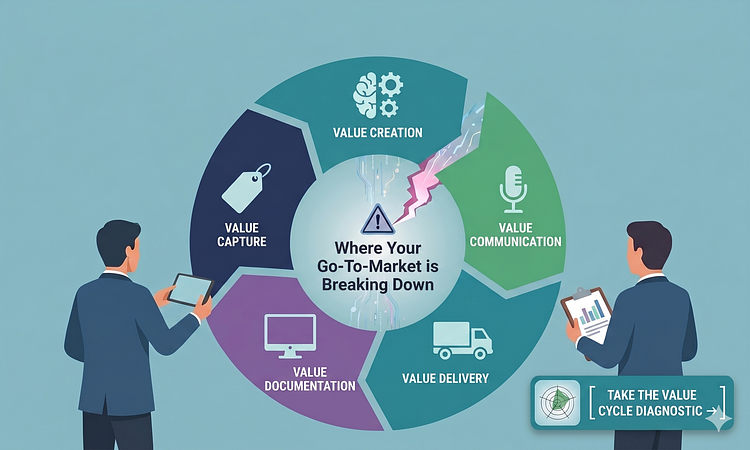
The Value Cycle: Where Your Go-To-Market Motion Is Breaking DownMost B2B SaaS leaders aren't asking "what's wrong with our pricing?" or "what's wrong with our messaging?" They're asking harder, messier questions:Why is our win rate flat even as we add headcount?Why aren't customers expanding the way the model said they would?Why does our value story land differently depending on which rep delivers it?Why does pricing always come up as an objection — even when our product is clearly better?These questions feel like separate problems. They aren't. They're symptoms of the same underlying issue: a break somewhere in the value cycle. The Value Cycle is a complete loopThe Value Cycle is the framework that defines how organizations create, communicate, deliver, document, and capture value. It is not a linear funnel. It is a closed loop where each stage feeds the next, and weakness in any stage limits what every other stage can produce.A company with a beautifully crafted value message can't sell on it if delivery doesn't follow through. A company with strong delivery can't capture fair pricing if the value isn't documented. A company with rigorous pricing can't sustain it if value isn't being created in the first place. The five stages connect — and the connections are where most B2B SaaS motions actually break.The five stages: The Value Cycle Value Creation — understanding what outcomes customers actually value, across segments, and versus the alternatives they're really considering.Value Communication — articulating that value to the right stakeholder at the right moment in the buying journey.Value Delivery — consistently delivering on the value promise, and proactively managing gaps when they occur.Value Documentation — systematically capturing and quantifying the value delivered, so it can be used in renewals and expansion.Value Capture — translating value delivered into pricing that captures a fair share of the value created.The interesting question isn't whether your company "does" each stage. Every B2B SaaS company does some version of all five. The question is which stage is the weakest — and what that weakness is costing you.What weakness in each stage looks likeWhen Value Creation is weak, the company's value propositions are inherited from the founding team or pieced together from anecdotal customer conversations. Different reps describe the product's value differently. Segment-specific value drivers either don't exist or live in someone's head. The fix isn't more marketing — it's structured customer research that produces a defensible, segment-specific view of what customers actually value.When Value Communication is weak, the same product gets pitched with the same deck to a $5M company and a $500M company. Win rates are inconsistent across reps because the message lives in the head of the best seller, not in a tested, documented framework. Buyers report that the value story didn't quite fit their situation. The fix is buyer-specific messaging grounded in research, validated through win/loss analysis, and reinforced consistently across the funnel.When Value Delivery is weak, customers buy the promise but don't experience it consistently. Customer Success operates on usage and adoption metrics rather than business outcomes. Renewals come down to relationships rather than demonstrated value. Expansion stalls because customers can't articulate what they got from the original investment. The fix is operationalizing delivery — documented playbooks, outcome metrics tied to customer-specific commitments, and proactive intervention when accounts trend off-track.When Value Documentation is weak, the company has plenty of customer success stories but very few quantified ones. Case studies are anecdotal. Sales decks reference "ROI" without being able to defend the number. Renewal conversations lean on relationship rather than evidence. The fix is building a structured value evidence base — quantified outcomes captured systematically, organized by segment, and actively used by sales, customer success, and pricing on every deal.When Value Capture is weak, pricing was set thoughtfully at some point but hasn't been revisited as the product, market, or customer base has evolved. Reps default to list price minus a discount. Discount levels creep upward over time. ACV stagnates even as the product genuinely delivers more value than it did a year ago. The fix is value-based pricing that varies by segment, supported by ongoing willingness-to-pay testing, and updated as evidence accumulates.Why the shape of the weakness mattersA company that scores low across all five stages has a fundamentally different problem than a company that scores well in four stages and badly in one. The first needs a foundational rebuild of its go-to-market motion. The second needs targeted intervention at a single point of the cycle — and the intervention will produce results faster, because the rest of the motion is already working.This is why composite scores are misleading. Two companies with the same overall score can be in completely different situations. The shape of the weakness — which stages are strong, which are weak, and where the breaks fall — is what determines what to fix and in what order.See where your motion is breakingThe Value Cycle Diagnostic is a five-minute, fifteen-question tool that produces a stage-by-stage read on your go-to-market motion. It doesn't ask for financial data. Every question is answerable from lived experience. The output is a personalized radar chart showing where your motion is strongest, where it's breaking down, and what specifically to address first.Click Here to take GTMP's Value Cycle Diagnostic
April 29, 2026Rashaqa Rahman

How to Increase Price Without Losing Your Best Customers

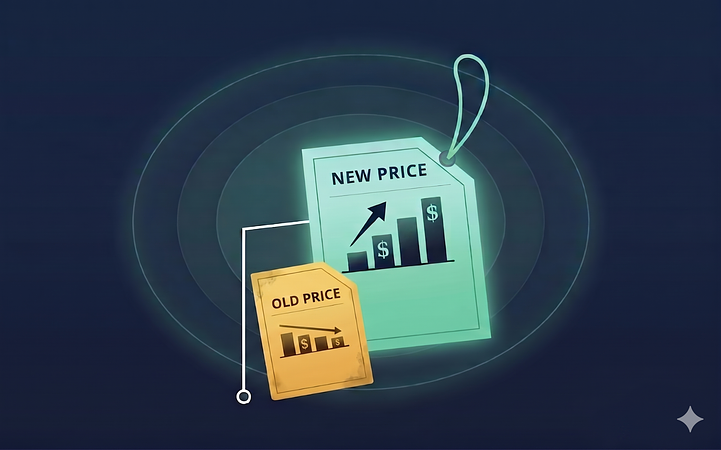
Are you putting off raising your pricing because you are worried about churn? Have your costs creeped up while your prices remained static? Do you suspect that your customers are getting an extraordinary deal for the price you are charging them?A well designed price increase can reset the relationship between the value you create and the value you capture. It can also fund continued investment in your product or service. However, done badly, it can erode trust, accelerate churn, and provide an opening to your competitors.The good news is that the customers most leaders fear losing in a price increase - that is, the larger deals, or most loyal or engaged customers, are rarely the ones who actually leave. The customers who leave are usually the ones you suspected were a poor fit anyway. But that only holds true when the price increase is well designed, well communicated and well executed.Segment Before You Raise PriceIf you service multiple customer segments -  not every customer should see the same increase. Different segments derive very different amounts of value from your offer in very different ways, and a flat price increase applied across the board is the wrong way to go.We recently worked with a SaaS organization whose pricing had not kept pace with how their customers were using the product. Heavy users derived enormous value from the platform, but paid roughly the same as light users on the same flat plan. So we designed a price increase that was structured around usage and value tiers. Heavy users absorbed a meaningful price increase because it was possible to articulate and quantify the value they were getting. Light users saw a small increase or none at all, with a clear pathway to more value creation over time.So start by segmenting by value before you decide who pays what.Start with ValueA price increase without a credible value story is just a bill that went up. A price increase rooted in a credible value story re-anchors the relationship with your customersAsk yourself honestly, what has changed since you last set prices? Have you introduced new capabilities? Are there new customer outcomes? Are there new industry benchmarks, or have you broadened your reach to new customer categories? Most organizations do not document the value they have added over the years. So start by surfacing it and quantify where possible. The value-based narrative you bring to support the  pricing increase determines whether there will be customer price acceptance or pushback..Choose the Right MechanismConsider whether you should be:Introducing a new pricing tier and migrating customers upAdjusting or introducing new pricing metrics (the unit by which you price) so it tracks how value is actually created - for example number of users, number of transactions, volumeRepackaging - moving features between tiers in a way that that better tracks value          Applying time-based phasing - applying the increase to new customers now, and existing customers at renewalThe best price increase mechanism for your business requires a deep understanding of how your customers buy, how they renew, and how much flexibility there is in your pricing architecture today.Communicate with ConfidenceThe single most common mistake we see is apologetic communication. A hesitant, defensive announcement signals to customers that you do not believe the new price is fair. Your customers will take their cue from you.So, be direct. Explain what is changing, when, and why. Most importantly anchor every communication in value. Give customers enough notice to plan. For your most strategic accounts, start early and have a real conversation with someone they trust.Protect the Right Customers, StrategicallyDo not grandfather everyone who pushes back. Grandfathering should be a strategic choice, not the default. Grandfather customers only when the relationship is genuinely strategic -  when the cost of churn is materially higher than the cost of the foregone increase.The Ones Who LeaveSome customers will leave, that is inevitable. The customers who churn over a well designed, well communicated price increase are usually the ones who were never getting fair value relative to the price being charged. A well designed and executed price increase is a clear signal that an organization understands the value it creates and that it intends to keep investing in ongoing value creation for its customers.We Can HelpAt GTM Pricing Innovations, we help B2B organizations design and execute price increases that capture a fair share of the value they create for their customers. If you have a price increase on the horizon and need support with execution, or you have been putting one off, or you are unsure where to start, we would love to talk.Reach out to us - let us help you with pricing design that strengthens your customer relationships rather than tests them.
April 28, 2026Karen Chiang

Building a Habit of Voice of Customer in 30 Days - Part 4 of 4 Operationalize

Week 4 (Days 22–30): Operationalize — Execute a Real DecisionThe difference between a VoC project and a VoC capability is this: a project ends with a report. A capability ends with a decision, a change, and a measurement plan. This final week of establishing your VoC habit, you make VoC real.Actions for the week:Pick one decision and execute it. Rewrite a section of your website using the outcome language your customers gave you. Adjust a pricing tier based on the value gap you identified. Change a qualification question in your sales process to reflect how customers actually describe the trigger for buying. One change, fully implemented.Instrument the impact. Define in advance what you'll measure: win rate, time-to-close, expansion rate, NPS, churn. You don't need a perfect attribution model — you need a baseline and a hypothesis. "If we reposition for this outcome, we expect demo-to-close to improve within sixty days."Set the cadence for what comes next. VoC doesn't end on Day 30. Schedule  regular VoC reviews; perhaps, thirty minutes with RevOps, GTM, and product to share one new insight and make one visible decision. This is how the muscle stays active.Document your first VoC cycle. Write a one-page internal summary: what you heard, what you changed, and what you're measuring. This becomes the template for every cycle that follows.What good looks like by Day 30: One GTM decision — messaging, packaging, pricing, or qualification — has been made and implemented based on direct customer evidence, with a measurement plan in place.Execution is Our Core MetricGTM Pricing helps commercial teams turn Voice of Customer from a sporadic exercise into a disciplined habit that shapes messaging, packaging, and pricing decisions every week. By partnering with GTM Pricing, you give your revenue operations, sales, and product leaders a shared, value‑based language grounded in real customer outcomes, not internal opinions.We deliver data-backed, operationalized strategies—not just theoretical advice. Our commitment is to ensure our recommendations are fully integrated through your Revenue Operations (RevOps) so that strategy actually sticks and scales.Want a clearer growth trajectory with predictable sustainable revenue? Let’s connect on LinkedIn! Contact me at GTM Pricing.Karen Chiang, Founder, Managing Director, Strategy & InnovationsGTM Pricing Innovations Inc.

Ready to See What Better Pricing Looks Like?

Book a 30-minute pricing diagnostic today. We'll identify your biggest pricing opportunities and give you our best advice on how to transform your pricing model.

Book Your Pricing Diagnostic →